Reeperbahn Festival ended its 21st edition in Hamburg on the night of Saturday 19 September. Four weeks later, with the closing figures published and the budget debate that shadowed the event still open, it is possible to say what kind of edition it was: a full one for the public, a slimmer one on paper for the industry, and one whose chosen motto, "Forever Legit?", ended up pointing back at the festival itself.
What the organisers counted
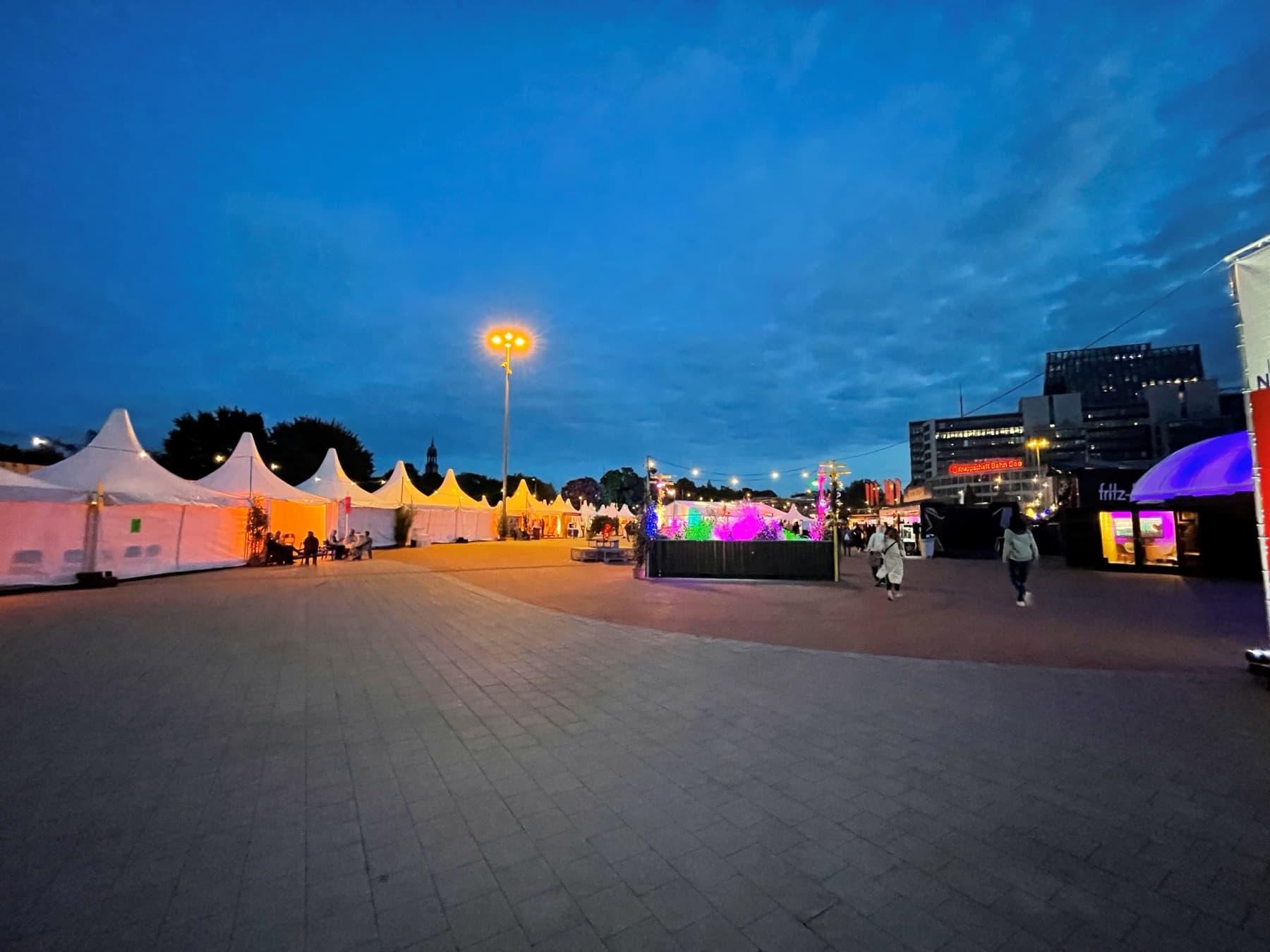
The closing press release gives about 45,000 visitors over four days. The music programme ran to roughly 540 concerts, 260 of them curated, by about 425 acts from 44 countries in more than 40 venues. The conference offered around 120 programme items with about 420 speakers from 31 nations, for some 5,500 trade visitors from 52 nations. The free Festival Village on the Heiligengeistfeld drew another 45,000 or so. In the curated line-up, the Keychange count was 53 per cent male and 47 per cent FLINTA musicians.
Set those lines beside the 2025 closing release and the shape changes. Last year the festival reported around 43,000 visitors and about 5,000 professionals, so both audiences grew. The acts came from 30 countries then and 44 now. But the 2025 release counted over 70 venues and 225 conference events, including partner conferences, with around 350 speakers.
The two releases are not built identically, and the festival does not comment on the difference. Even so, the direction is visible: more people and more countries passing through a programme described with fewer rooms and fewer sessions. A City of Hamburg release issued two days before opening had still spoken of around 70 venues and expected about 6,000 trade visitors.
A motto aimed at the next generation
"Forever Legit?" was meant as a question to the business. The festival's announcement of the theme argued that the legitimacy of the music ecosystem has to be renegotiated as younger audiences change how they go out, listen and pay. It came with a structural gesture: Future Minds, a programme advisory panel for people aged 18 to 27, set up with Hamburg Music Business.
Two new formats pushed the conference towards specialisation. MUSIC FRONTIERS, a two-day conference on technology and AI held with MusicTech Germany on 17 and 18 September, was folded into the programme. "The music industry is facing one of the biggest upheavals in its history," the association's president, Matthias Strobel, said in the festival's release. And a "Spotlight On" strand, starting with heavy music, offered genre specialists a cheaper ticket limited to their own corner of the event.
Both are ways of selling a showcase conference in slices. That is a commercial answer to the motto's question as much as an editorial one.
Ukraine, and an award that stayed with the guest
The edition also introduced a Guest Country of Honour, and chose Ukraine, represented by Music Export Ukraine. "This commitment deserves the highest recognition," festival director Detlef Schwarte said in the announcement, citing the organisation's work under extreme circumstances.
The Anchor, the festival's international award for new talent, then went to a Ukrainian artist. GANNA was chosen from six nominees and named on the Friday evening at the St. Pauli Theater, by a jury of the songwriter Jerry Heil, Oklou, Domiziana and Sega Bodega. The closing release describes her music as drawing on the folk traditions of her country and modern beats, and calls the result a surprising further high point for the guest country.
The money
The harder legitimacy question was being asked in Berlin. In August, ZDF reported that the federal government planned 3 million euros for the festival in 2027, against 8.2 million in 2024. Germany's culture minister of state, Wolfram Weimer, told the broadcaster, in our translation: "With the Reeperbahn Festival, it is Hamburg's move." Rolling Stone Germany put the intermediate steps at 6.27 million euros in 2025 and about 4.5 million for 2026.
Hamburg's culture senator, Carsten Brosda, rejected the framing. "With the Reeperbahn Festival we are really talking about economic development," he told ZDF, also in our translation, arguing that an international marketplace for music is a federal task. In the city's pre-festival release he promised that Hamburg would stay at the festival's side and asked for a clear commitment to it from beyond Hamburg.
Nothing in the organisers' releases links the size of this year's programme to the grant, and this piece does not claim a link. But the two sets of numbers now sit side by side, and they describe the dilemma of every showcase festival that runs on public money. Its public is a paying crowd. Its real customer is an industry that expects the meeting place to exist. Who pays for that expectation is exactly what Berlin and Hamburg are arguing about.
What to watch
- The 2027 federal budget. ZDF reported that the culture ministry considers it normal for budget lines to be raised during the parliamentary process, and left open whether that will happen here. The figure to track is the 3 million euros planned for 2027.
- 15 to 19 September 2027. The dates shown on the festival's website for the next edition, with early bird festival and conference tickets already on sale.
- Next year's count. Venues, conference items and trade visitors in the 2027 closing release, set against this year's 40-plus, 120 and 5,500.
- Future Minds. Whether the youth advisory panel is credited with programme decisions in 2027, which would be the motto's most concrete result.
Sources: Reeperbahn Festival press releases on the close of the 2026 edition (in German), the close of the 2025 edition, the "Forever Legit?" theme, MUSIC FRONTIERS and Spotlight On and Ukraine as Guest Country of Honour, all listed on the festival's press page; the City of Hamburg's press release of 14 September 2026; ZDF heute (8 August 2026) and Rolling Stone Germany (21 September 2026) on federal funding. Quotes from Wolfram Weimer and Carsten Brosda translated from German by Music to See.